Skip to content

DOUG HESS, ASSISTANT PROFESSOR, DEPARTMENT OF POLITICAL SCIENCE, GRINNELL COLLEGE

Iowa Ranks Low in the School Breakfast Program

The School Breakfast Program, like the more familiar National School Lunch Program, provides subsidized meals to school children. Researchers have found that eating a nutritional breakfast at school improves students’ academic performance, reduces disciplinary problems, and increases the likelihood that students eat a healthful meal.

Unfortunately, when it comes to reaching children from low-income households with this program Iowa has long ranked near the bottom of states. On an average day in October 2013, Iowa served approximately 40 free and reduced-price breakfasts for every 100 free and reduced-price lunches.  Based on a similar score, the Food Research and Action Center, a national nonprofit organization that studies hunger in the United States and advocates for nutrition and anti-hunger policies, ranks Iowa’s School Breakfast Program coverage as 47th out of 50 states and DC.

Assuming October to be representative of the school year, our state’s poor performance means that thousands of low-income children in Iowa are failing to access this important program. What might explain this? And should we be concerned?

Of course, some families and children may not choose to participate in the program. But long bus-rides, increases in the number of school children in poverty, and the demonstrated benefits of the program means we should think through making the program as accessible as possible.

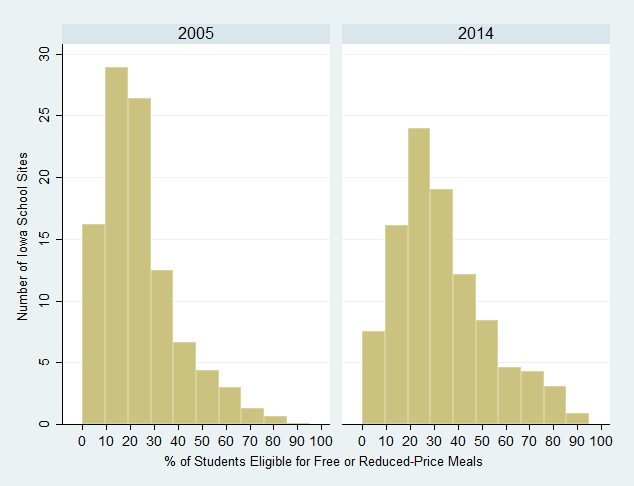
The figure below includes two histograms showing the increasing number of school sites (that is, elementary, middle school, and secondary schools) with larger percentages of children eligible for free and reduced-price meals.  According to Census data, the percentage of Iowa school children from households at or below the poverty line rose by approximately 2.5 points during this period. Of course, as the state grows the absolute number of children in poverty grows as well (unless the rate were to fall). In the end, the rate increase and the growth in population means approximately 20,000 more students from families in poverty attend Iowa schools compared to just a decade ago.
Percent of students eligible for free or reduced-price meals by number of Iowa school sites

Read More »Iowa Ranks Low in the School Breakfast Program

Access to Research Includes Access to Data!

In February 2013, the Director of the White House Office of Science and Technology Policy (OSTP) issued a memorandum to all agency and department heads entitled, “Increasing Access to the Results of Federally Funded Scientific Research”.

The memo directed federal agencies that award more than $100 million in research grants to develop plans for increasing public access to peer-reviewed scientific publications. It also requires researchers to better account for and manage the digital data resulting from their federally funded research. (At the same time, the OSTP directive acknowledges that access to some data needs to be controlled to protect human privacy, confidentiality of business secrets, intellectual property interests, and other reasons.)

The OSTP recognizes that research data are valuable and need to be preserved. Increased public access to data – along with better access to the published literature – is fundamental to research, and permits

  • more thorough critiques of theories and interpretations, including replication of research results,
  • scholarly innovation that builds on past work, and
  • practical application of scholarly discoveries.

Read More »Access to Research Includes Access to Data!

A Network Analysis of Shakespeare’s Plays, Part 2: Revising the Social Disorder Hypothesis

In my last post, I described how network visualization represents the beginnings of a method that will allow us to read between the written playtext and the theatrical performance. Its digital method focuses our critical gaze on the exchange between the words and bodies that work together to define Shakespearean performance by transmuting the words of the playtext into character relationships in space. We will compare the network graphs with the language of the playtexts and with still images from performances, to substantiate our claims at three levels of analysis. Using the network visualizations, we aim to address a pressing question in the digital humanities today: can computational methods can teach us something new about literary texts, or do algorithms and visualizations simply confirm readings, arguments, and theories we already know well. The promise of the network method lies precisely in offering to critics a new vantage point that would otherwise not be possible through a conventional reading of the text. The network allows us to rethink one of the oldest stories in Shakespeare criticism and pedagogy, what we will call the social disorder hypothesis. Since A.C. Bradley influentially defined the essence of Shakespearean tragedy as “division of spirit involving conflict and waste,” and not the ultimate reconciliation or renewal suggested by Hegel, generations of critics to the present have described the tragic nature of Hamlet in terms of thanatos: confusion, destruction, and violence that violates natural law, ethics, and social order. Readers of the comedies have developed a parallel hypothesis on social disorder in accounts of the carnivalesque. Drawing inspiration from the work of Mikhail Bakhtin in Rabelais and his World, a long tradition of critics has focused on the inversions and disorderings of political and sexual hierarchies opened up in the chaos of Shakespeare’s comedies. In this story told about Shakespeare, the tragedies and comedies draw their power and enduring interest from the subversive representation of social disorder. For the sake of space, the present argument focuses on Shakespeare’s tragedies, and acknowledges that the comedies and histories require further analysis.

Figure 1
Figure 1. Hamlet, Act 5, Scene 2

This canonical account of Shakespearean drama as a fictional space for the eruption of disorder severing social bonds and overthrowing political hierarchies certainly holds true at the level of plot, and Act 5, Scene 2 of Hamlet is one of the most striking examples of this. However, the critical vocabulary of entropy and chaos – incoherence, conflict, waste, violence, destruction, scattering and disproportion – used describe tragic plot as the unraveling of society and the destruction of human bonds, fails to capture the dramatic technique required in a performance to represent this “scattering” of the social on stage. The network in Figure 1 demonstrates that scenes of a tragic “scattering” disorder and the most disruptive and violent severing of social bonds are precisely the moments where the closest connections between characters are made, and the densest concatenation of network links exists.

Read More »A Network Analysis of Shakespeare’s Plays, Part 2: Revising the Social Disorder Hypothesis